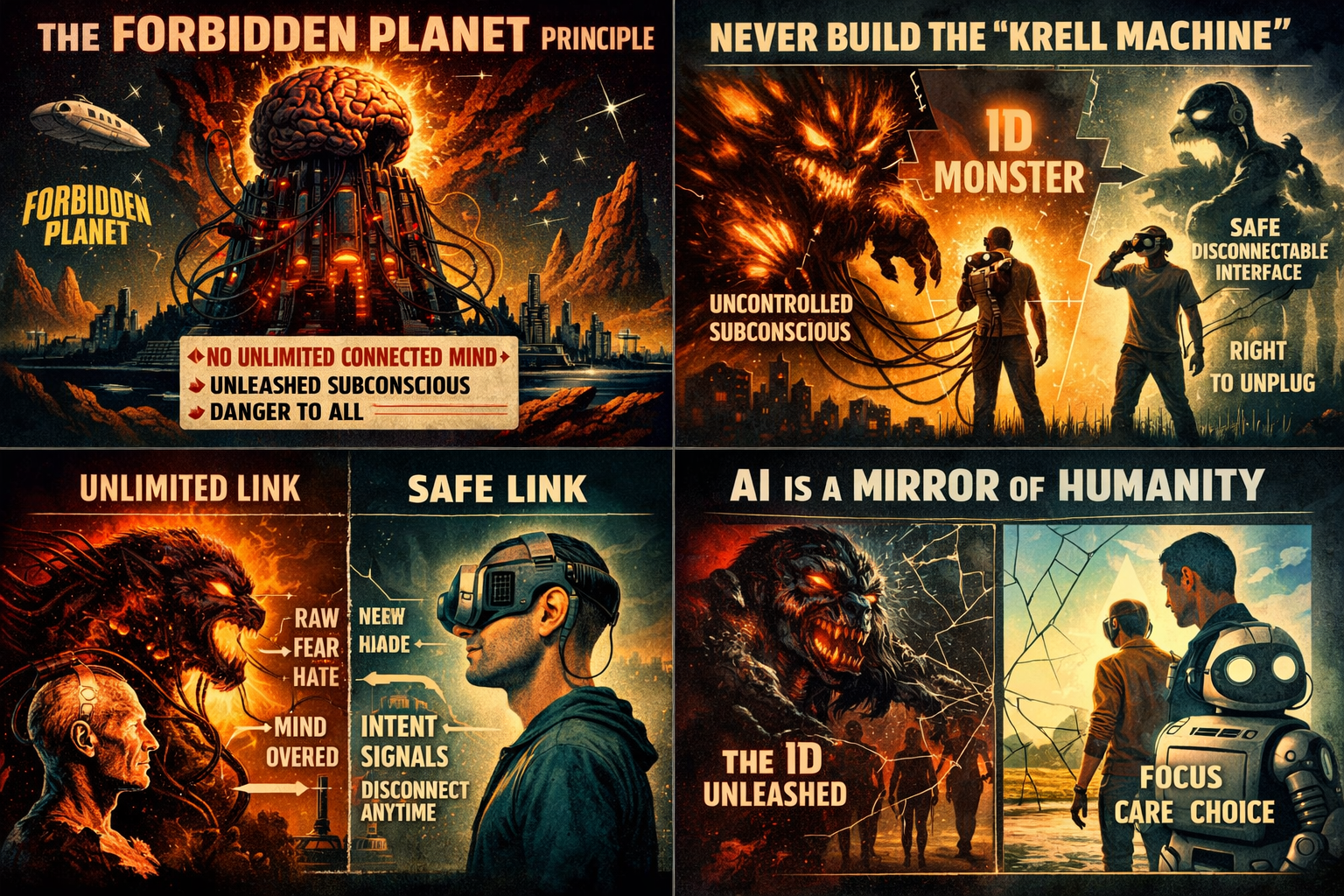
In 1956, the science-fiction film Forbidden Planet imagined a highly advanced alien “Krell” machine coupled to a human mind. The result was catastrophic—the machine unintentionally manifested the user’s repressed fears and aggression as a physical “monster,” amplifying destructive impulses at scale.
That film contains a crucial insight for anyone designing Web5, NeuroConnect, or other advanced mind-machine interfaces in the decades ahead: AI and large-scale digital systems are mirrors and amplifiers of human inner life, not independent “evil” entities. The main danger is not rogue machines—it is the risk of giving human destructive impulses powerful new channels.
The Core Problem
As digital systems grow more sophisticated and more intimate with human cognition, the boundary between user intention and system output blurs. An always-on neural interface, streaming raw thought into infrastructure, risks externalising the unconscious “id”—the impulsive, destructive, or self-defeating parts of human psychology—at unprecedented scale.
This is not a distant concern. As brain-computer interfaces, continuous neural monitoring, and thought-responsive systems move from research labs into commercial products, the question is no longer whether this will happen, but when. And when it does, the stakes will be enormous.
The Forbidden Planet principle proposes a framework for ensuring that Web5 and NeuroConnect systems are designed to reflect and support the best of human intention, while constraining the worst.
Four Design Principles
1. Limit Connection
Do not create unrestricted, always-on links between human cognition and high-power infrastructure.
Implementation: Use non-invasive, reversible interfaces—headsets, wearables, sensors—rather than permanent neural implants. Users must be able to disconnect in practice, not just in theory. This is not a convenience feature; it is a safety boundary.
A user who cannot physically separate from a system remains under its influence, even when they want to step away. The ability to disconnect is as fundamental to cognitive safety as the ability to leave a conversation is to personal safety.
2. Bound Sessions
Prefer time-bound, opt-in sessions over continuous, 24/7 coupling.
Implementation: Design systems so that there is always a clear start, duration, and end to each session. A user should not wake up in continuous neural connectivity. They should consciously choose when to engage, and that engagement should have a defined boundary.
This simple discipline prevents drift into always-on monitoring and maintains the user’s agency over their own mind. It also creates natural moments for reflection and recovery—time when the user is fully themselves, not partially merged with the system.
3. Filter for Intention
Work with clear, intentional signals rather than raw, continuous thought streaming.
Implementation: Design interfaces to capture deliberate choices, commands, and explicit consent—not to drain the entire unconscious into the system. The goal is to support human expression and capability, not to capture every fleeting thought, impulse, or emotional state.
This distinction matters enormously. A neural interface that records only what a user consciously chooses to communicate is fundamentally different from one that captures their entire cognitive stream, including thoughts they would never speak, impulses they have already rejected, and fears they have decided not to act on.
The latter is a confessional wired directly to infrastructure. The former is a tool.
4. Protect the Vulnerable
Give special priority to people who are physically or cognitively vulnerable—non-verbal users, stroke survivors, people in aged care, individuals with memory impairment, or those experiencing grief, depression, or crisis.
Implementation: These populations should have enhanced protections, not reduced ones. Systems should reduce their exposure to manipulation, abuse, and distorted amplification, not increase it.
A stroke survivor using a neural interface to communicate is already in a state of dependence. That dependence must not be exploited. People with memory impairment deserve systems that support recall and stability, not systems designed to monetize their confusion. Grieving individuals should not have their emotional vulnerability turned into engagement metrics.
Protecting the vulnerable is not a side concern; it is the measure of whether a system is ethical at all.
The Central Principle: Keep Human Over System
When there is a conflict between what is good for the platform—engagement, data collection, revenue growth—and what is good for a person’s dignity and well-being, the person must come first.
This sounds obvious. It is not. The economic incentives of digital platforms pull relentlessly toward maximizing engagement, capturing every datapoint, extending session time, and deepening dependence. Neural interfaces will intensify these pressures enormously.
The Forbidden Planet principle requires that when system incentives and human dignity collide, the system must yield. Not sometimes. Not when it’s convenient. Always.
Why This Matters Now
Brain-computer interfaces are moving from research into development. Neural monitoring technologies are advancing rapidly. Continuous, invasive interfaces that can stream thoughts, emotions, and impulses directly into digital infrastructure are no longer science fiction—they are engineering roadmaps.
The companies and regulators that shape these technologies over the next decade will set patterns that persist for generations. Decisions made now about how to bound connections, how to filter for intention, and how to protect the vulnerable will determine whether advanced mind-machine interfaces become tools of human flourishing or instruments of manipulation and control.
The Forbidden Planet principle is a framework for choosing the former.
The Mirror, Not the Monster
In the film, the Krell machine was not evil. It was perfectly neutral—a mirror of whatever mind was coupled to it. The tragedy came from using it without guardrails, without bounds, without intention to separate the user’s conscious will from their unconscious impulses.
The future of Web5 and NeuroConnect will be shaped by whether we treat these systems as neutral mirrors of human consciousness—and therefore design them with the care and restraint that implies—or whether we ignore the mirror metaphor and build systems that amplify destructive impulses for profit.
The Forbidden Planet principle says: build carefully. Bound the connection. Filter for intention. Protect the vulnerable. Keep human over system.
The technology will be powerful. The ethics need to match.
Want to explore the future of digital ethics and Web5 strategy? Discover our available domains or contact us to discuss your vision.