The promise of Society 5.0 is powerful: a world where cyberspace and the physical world work together to support human life. Japan’s own framing emphasises a human-centred future, and more recent strategy documents describe a society shaped by digital twins, AI and human–cyber-physical integration.
But if society becomes more connected, one principle becomes more important than ever:
Humans must always be able to disconnect.
The Risk of Permanent Entanglement
This is where the Forbidden Planet principle comes in.
The idea is simple. If you create a world where human minds, emotions and impulses are permanently entangled with powerful digital systems, you do not just get efficiency. You risk turning fear, rage, envy and obsession into infrastructure.
In practical terms, that means future systems should be:
- Non-invasive, not implant-first — Use headsets, wearables, and external interfaces rather than permanent neural implants
- Session-based, not always-on — Create systems with defined start and end times, not 24/7 coupling
- Built around clear intentional signals, not raw mental streaming — Capture deliberate choices and commands, not continuous thought feeds
- Designed so the human can always say stop — The ability to disconnect must be built into the system, not added as an afterthought
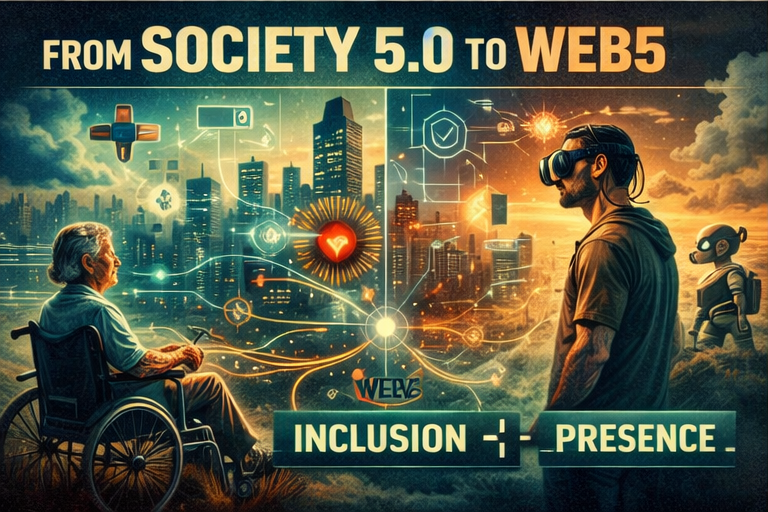
This is not anti-technology. It is pro-balance.
Global Ethical Consensus
That view also lines up with current neurotechnology ethics debates. The OECD has stressed privacy, cognitive liberty and autonomy in neurotechnology innovation, and UNESCO warns that AI-linked neurotechnology can threaten dignity, autonomy and mental privacy if not governed properly.
In November 2025, UNESCO adopted a global Recommendation on the Ethics of Neurotechnology—the first major international agreement on how to govern brain-computer interfaces and neural monitoring. The consensus is clear: humans need protection from permanent, invasive, and invasive integration with digital systems.
That consensus matters because it shows this is not a fringe concern. It is central to how the global technology community understands ethical innovation in neurotechnology.
The Balance: Technology That Serves, Not Consumes
A good Society 5.0 is not one where humans are fused to systems all day.
It is one where technology helps people when needed—and then lets them go quiet again.
This matters for:
- Mental health — People need time away from connectivity to rest, reflect, and recover
- Autonomy — The ability to think, feel, and decide without system influence or surveillance
- Privacy — Inner life remains private, not streamed into infrastructure
- Dignity — Humans remain subjects, not data sources or engagement metrics
- Childhood and development — Young people need space to grow without permanent digital coupling
- Diversity — Different people need different levels of connection; one system cannot fit all
Practical Design for Disconnection
Making this real means:
- Building systems that default to session-based use, not continuous monitoring
- Designing interfaces that respect intentional engagement, not capture every impulse
- Creating audit trails and user controls so people know what’s being collected
- Ensuring that “opt-out” is as easy as “opt-in”
- Protecting people who are vulnerable to exploitation or dependence
- Designing for graceful disconnection, not withdrawal symptoms
See Also
Explore related frameworks:
- Society 5.0 Needs More Than Smart Cities — Why infrastructure alone is not enough
- Web5 / NeuroConnect: The Next Human Layer of Smart Society — How digital sovereignty connects to Society 5.0
- The Forbidden Planet Principle — The full safety framework for advanced mind-machine interfaces
- Society 5.0—AI as Partners, Not Masters — Why human dignity must guide technology
The technology of Society 5.0 will be built. The question is whether it will be built with an off-switch—with clear, enforceable guarantees that humans can disconnect and remain fully themselves.
That is not a limitation. It is a foundation.
Ready to explore the future of Society 5.0? Discover our available domains or contact us to discuss Web5 and digital sovereignty strategy.